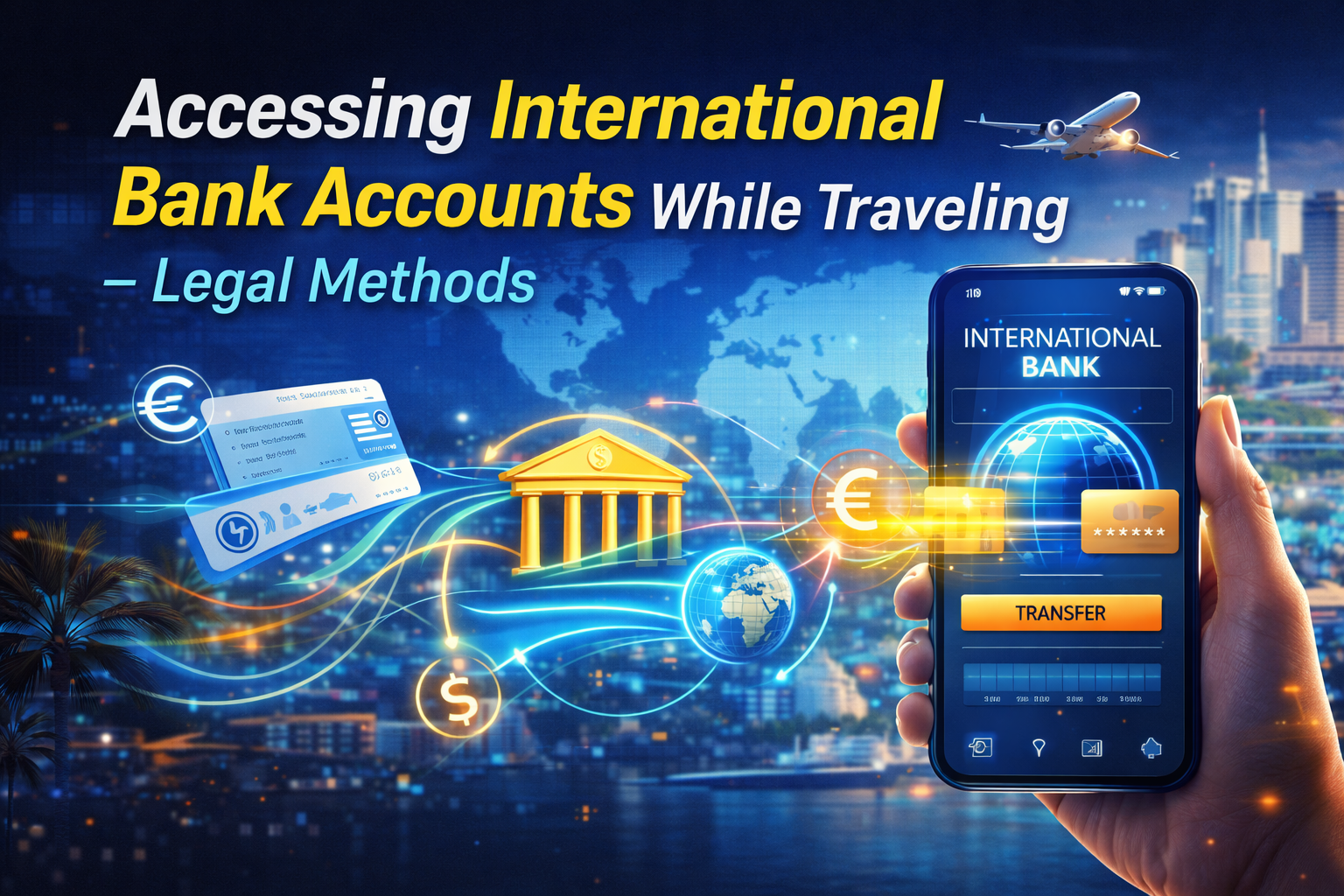
Accessing International Bank Accounts While Traveling – Legal Methods
Over 800,000 Americans now maintain foreign financial accounts, and that number continues climbing as remote work and international travel become mainstream. Whether you’re managing overseas income, traveling for months, or keeping funds in multiple countries, knowing how to access these accounts legally prevents costly freezes and penalties.
Understanding International Bank Account Access
An international bank account enables financial transactions across borders, currency exchanges, and worldwide fund access. These specialized accounts differ from standard domestic accounts by supporting multiple currencies, offering global ATM networks, and providing reduced foreign transaction fees.
Banks like HSBC, Citibank, and Wise operate across dozens of countries, making them practical choices for frequent travelers. Traditional institutions typically require higher minimum balances, while fintech alternatives like Revolut or N26 offer lower barriers to entry with competitive exchange rates.
The key distinction lies in accessibility. Domestic accounts can trigger fraud alerts when used abroad, potentially freezing your funds at airports or hotels. International accounts anticipate cross-border activity, reducing disruption during travel.
Legal Requirements for U.S. Account Holders
Americans with foreign accounts face mandatory reporting obligations that, when ignored, result in severe penalties.
FBAR Filing Requirements
U.S. persons must file FinCEN Form 114 (FBAR) if their combined foreign financial accounts exceeded $10,000 at any point during the calendar year. This threshold applies to the aggregate total, not individual accounts.
The FBAR deadline falls on April 15, with an automatic extension to October 15. Unlike tax returns, this extension requires no formal request. Electronic filing through the BSA E-Filing system is mandatory; paper submissions are not accepted.
FATCA Compliance (Form 8938)
Form 8938 requires reporting of specified foreign financial assets, filed with your annual income tax return. Thresholds vary based on residency and filing status.
For individuals living abroad, single filers report when foreign assets exceed $200,000 on the last day of the tax year. Joint filers double these thresholds. U.S. residents face lower limits: $50,000 for singles, $100,000 for joint filers.
Both forms serve distinct purposes. FBAR goes to FinCEN, while Form 8938 files with the IRS. Many situations require filing both, as they cover different asset types and have separate reporting criteria.
Maximum penalties for non-willful FBAR violations reach $16,536 per violation, while willful violations incur penalties of the greater of $165,353 or 50% of the account balance. These consequences make compliance essential.
Best Banks for International Travel Access
Selecting the right banking partner determines whether your trip proceeds smoothly or becomes a financial headache.
Traditional Global Banks
HSBC maintains branches in over 60 countries, with their Premier Expat package offering waived ATM charges worldwide, multicurrency accounts, and Premier status extended to four family members. Account opening begins online with KYC video verification and proof of U.S. address.
Citibank provides ATM withdrawals at locations in more than 20 countries and delivers foreign currency by the next business day to branches, homes, or offices. Their global presence makes them reliable for travelers needing physical branch access.
Fintech Solutions
Wise supports over 40 currencies, provides local bank details in multiple countries, and uses the real exchange rate with low fees. The mobile app simplifies cross-border finances for freelancers and remote workers.
Revolut offers instant currency conversion, spending in 30+ currencies, and features like crypto and travel rewards. Premium tiers eliminate most foreign transaction fees, though weekend exchanges carry surcharges.
Charles Schwab High Yield Checking remains popular with U.S. expats, featuring no foreign transaction fees and unlimited worldwide ATM fee rebates. The account suits Americans spending extended periods abroad.
European Options
N26 operates across Europe with transparent fees and fast Euro account setup. The mobile-first approach appeals to students and remote workers in the Eurozone, though recent regulatory compliance has created waiting lists for new customers.
Preventing Account Freezes While Traveling
Banks monitor transactions for fraud, and foreign activity often triggers security holds.
Setting Travel Notifications
Major credit issuers like American Express, Chase, and Capital One no longer require travel notices due to advanced fraud detection technology powered by machine learning and artificial intelligence. However, regional banks and credit unions typically maintain this requirement.
Citi, Discover, and U.S. Bank still recommend travel notices for international trips, which can be set through mobile apps under Card Management or Account Services sections.
For debit cards and checking accounts, notification remains advisable. When you inform your bank about travel plans, they add a record to your account and share it with their fraud detection system, preventing your “abnormal” spending patterns from triggering blocks.
Real-Time Account Monitoring
Set up transaction alerts through your bank’s mobile app to receive instant notifications for purchases exceeding specified amounts. This enables immediate response to unauthorized charges before they escalate.
Enable card controls that allow you to temporarily freeze cards through the app if lost or stolen. Most banking apps now include this feature, providing quick security without lengthy customer service calls.
Maintaining Multiple Payment Methods
Carry at least two payment cards from different banks, storing backup cards separately from your primary wallet. If one card gets frozen, the second ensures continued access to funds.
Consider adding a prepaid travel money card as an additional backup. These cards work independently from your main accounts, providing emergency funds if primary cards fail.
Accessing Funds Across Borders
Different methods suit different travel situations and durations.
ATM Withdrawals
The average total fee for using an out-of-network ATM is $4.77, according to Bankrate’s 2024 Checking Account and ATM Fee Study. International transactions may add surcharges.
Choose accounts offering global ATM fee reimbursements or access to extensive fee-free networks. Amerant Bank customers access 50,000 ATMs worldwide within the AllPoint network.
Research ATMs affiliated with your bank before traveling to avoid unexpected fees. Withdraw larger amounts less frequently to minimize transaction charges.
Currency Exchange Strategies
Exchange rates directly impact the cost of goods and services purchased abroad; favorable rates mean you get more foreign currency for your money. Banks offering rates close to market rates with minimal markup provide the best value.
Avoid dynamic currency conversion when paying by card. If given the option to pay in your home currency or local currency, always select local currency. Dynamic conversion typically includes hidden markups of 3-7%.
Wire Transfers
Wire transfers are an option for accessing funds abroad and typically exchange easily for foreign currency, but they involve processing fees and can take several days. This method suits larger transfers where speed isn’t critical.
Consider services like Wise or OFX for international transfers, as they often provide better rates and lower fees than traditional banks.
Multi-Currency Account Management
Holding multiple currencies reduces conversion costs and protects against exchange rate fluctuations.
Benefits of Currency Diversification
When you maintain balances in currencies you regularly use, you eliminate repeated conversion fees. A digital nomad rotating between Thailand, Portugal, and Mexico benefits from holding Thai baht, euros, and Mexican pesos.
Multi-currency accounts also enable you to convert funds when exchange rates favor your home currency, rather than accepting whatever rate applies when you need to spend.
Account Structure Strategies
Keep a primary operating account in your home currency for fixed obligations like subscriptions or loan payments. Use secondary currency accounts for local expenses in countries where you spend significant time.
Some platforms allow internal currency exchange at interbank rates, making them more cost-effective than converting through credit cards or ATMs.
Security Measures for Foreign Account Access
Protecting accounts while traveling requires additional vigilance beyond domestic precautions.
Digital Security
Never access bank accounts through public Wi-Fi networks. Airports, cafes, and hotels often have compromised networks that expose login credentials. Use mobile data or a VPN for all financial transactions.
Virtual Private Networks encrypt your internet connection, making it significantly harder for attackers to intercept banking data. This becomes essential when traveling through regions with less stringent cybersecurity standards.
Physical Security
Store account information, emergency contact numbers, and backup cards in separate locations. Keep digital copies of important documents in encrypted cloud storage accessible from any location.
Money belts or hidden travel wallets reduce pickpocketing risk. Avoid carrying large cash amounts, mixing payment methods instead for better security and tracking.
Account Monitoring
Review transactions daily through mobile apps to catch unauthorized charges immediately. Banks typically provide stronger fraud protection when you report issues within 24-48 hours.
Consider setting low transaction limits for cards used in higher-risk locations. You can increase limits temporarily through banking apps when making larger purchases.
Common Mistakes to Avoid
Simple oversights cause most international banking problems.
Using Foreign Addresses
Banks may freeze or close accounts when they detect mail forwarding, P.O. box, or foreign addresses. U.S. banks typically require domestic addresses for compliance with regulations.
Maintain a legitimate U.S. address through family members or mail forwarding services that provide street addresses rather than P.O. boxes. Update banks with this information before extended travel.
Neglecting Paperless Options
Opt for paperless statements and email notifications to avoid mail delivery issues while abroad. Electronic statements arrive immediately and provide the same legal documentation as paper versions.
Forgetting Time Zone Differences
Customer service hours follow the bank’s local time, which may not align with your travel location. Before departing, save international customer service numbers that operate 24/7.
Overlooking Fee Structures
Many banks charge a percentage of each transaction, typically 1-3%, for purchases made in foreign currency. These fees accumulate quickly on extended trips.
Review your account’s fee schedule specifically for international transactions, ATM withdrawals, and currency conversions. Consider opening fee-free alternatives before travel rather than accepting expensive charges.
Managing Accounts During Extended Travel
Long-term travelers face unique challenges requiring proactive strategies.
Maintaining Account Activity
Banks may freeze accounts showing no activity for extended periods. Schedule small recurring transactions to demonstrate regular use, preventing dormancy flags.
Updating Contact Information
Ensure your bank has current email addresses and international phone numbers where you can receive security alerts. Two-factor authentication often requires SMS verification, which fails with inactive U.S. phone numbers.
Consider maintaining a U.S. phone number through services that provide SMS forwarding, as many banks still rely on phone-based verification for security.
Tax Implications
Income earned from foreign accounts remains subject to U.S. taxation regardless of where you physically reside. Track all foreign income carefully for accurate tax reporting.
Maintain detailed records of account statements, currency conversion rates, and transfer documentation. These records become essential if tax authorities request verification.
Emergency Account Access
Prepare for worst-case scenarios before they occur.
Lost or Stolen Cards
Contact your bank immediately through their 24/7 fraud hotline. Most banks can overnight replacement cards to international addresses or provide emergency cash advances.
HSBC account holders can access up to $10,000 in emergency cash in U.S. dollars or local currency if they lose their wallet while traveling.
Account Lockouts
If fraud detection systems freeze your account incorrectly, you’ll need to verify your identity. Having backup documentation like passport copies, recent statements, and proof of travel speeds resolution.
Contact customer service during their business hours for faster resolution. Evening or weekend calls may reach only automated systems or limited-authority representatives.
Backup Funding Sources
Maintain at least one completely separate financial institution relationship as emergency backup. If your primary bank experiences system outages or compliance holds, alternative access proves essential.
FAQ
Do I need to report foreign bank accounts if I only use them while traveling?
Yes, if your combined foreign account balances exceeded $10,000 at any point during the year, FBAR filing is mandatory regardless of how frequently you use the accounts.
Can banks legally freeze my account for traveling?
Banks can freeze accounts when transaction patterns appear suspicious, but proper travel notifications typically prevent this, and you can resolve freezes by verifying your identity and travel plans.
What’s the difference between FBAR and FATCA reporting?
FBAR reports foreign financial accounts to FinCEN with a $10,000 threshold, while FATCA reports broader foreign assets to the IRS with higher thresholds that vary based on residency.
Will my U.S. bank allow me to keep my account if I live abroad permanently?
Most U.S. banks require a domestic address, so maintaining your account typically requires using a family member’s address or mail forwarding service with a street address.
How long does it take to resolve a frozen account while traveling?
Resolution timeframes range from a few hours for simple verification to several days for suspected fraud, making immediate contact with your bank’s fraud department essential.
Are multi-currency accounts taxable differently than single-currency accounts?
No, the IRS taxes all foreign account income identically regardless of how many currencies you hold, with reporting requirements based on aggregate account values.
Loading newsletter form...