
Business VPN vs Consumer VPN: What Actually Sets Them Apart
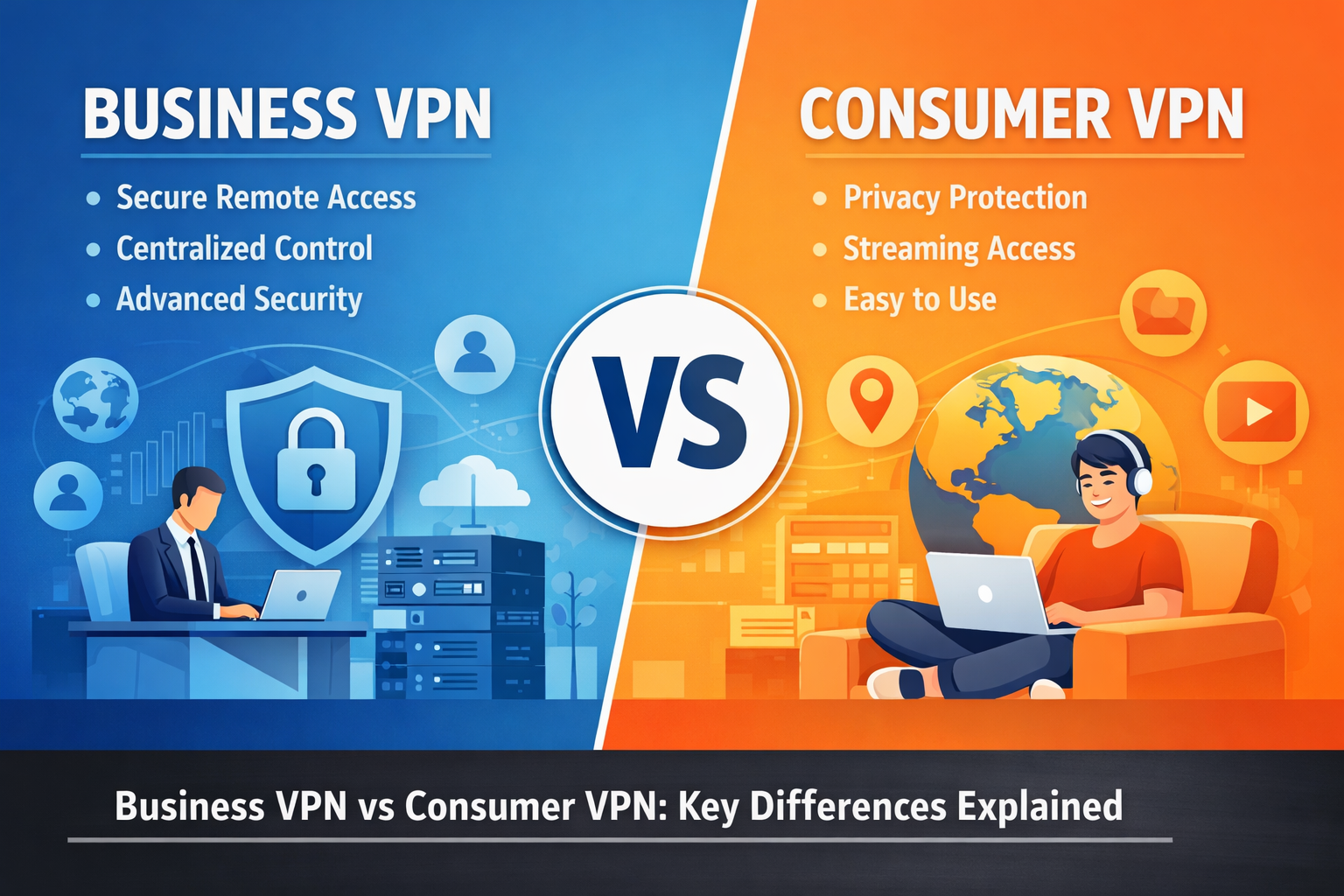
As digital security becomes a priority for both individuals and organizations, virtual private networks have moved from optional tools to essential infrastructure. Yet, the term “VPN” often creates confusion, especially when comparing consumer solutions with business-grade systems.
At a glance, both appear to offer the same function: encrypting internet traffic and protecting user data. In reality, they are built for entirely different purposes.
Understanding the Core Difference
A consumer VPN is designed for individual users. Its primary goal is to provide privacy, secure browsing, and access to restricted content. It is simple, easy to use, and requires minimal setup.
A business VPN serves a much broader role. It is not just a privacy tool but a secure access system that allows teams to connect safely to internal networks, regardless of their location.
This difference influences how each type performs, scales, and protects data.
Feature Comparison
| Feature | Consumer VPN | Business VPN |
|---|---|---|
| Primary Use | Personal privacy and streaming | Secure organizational access |
| Users | Single user | Multiple users with roles |
| Access Control | Limited | Role-based permissions |
| Security | Standard encryption | Advanced security layers |
| Monitoring | Not available | Full activity visibility |
| Scalability | Limited | Built for growth |
| Performance Focus | Speed | Stability and reliability |
Security Goes Beyond Encryption
Encryption is often seen as the defining feature of any VPN. While both types use strong encryption protocols, the level of protection they offer is not the same.
Consumer VPNs focus on securing the connection between the user and the internet. This is sufficient for everyday use such as browsing or streaming.
Business VPNs operate on a deeper level. They integrate with internal systems and enforce strict access controls. Features like multi-factor authentication and user-level permissions ensure that sensitive data remains protected at all times.
Control and Management
One of the most important differences lies in control.
A consumer VPN works independently. Once connected, it provides privacy, but there is no system in place to manage users or monitor activity.
A business VPN, however, provides centralized control. Administrators can define who has access to specific resources, monitor usage, and enforce security policies across the entire organization.
This level of control is essential for companies handling confidential data or operating with remote teams.
Performance and Reliability
Consumer VPNs are optimized for speed, especially for activities like streaming or general browsing.
Business VPNs focus on reliability. The goal is to maintain a stable and secure connection for multiple users, even during high demand. Consistency is prioritized over raw speed.
Scalability Matters
Consumer VPNs are built for individual use and do not scale effectively.
Business VPNs are designed to grow with an organization. Whether it is a small team or a large enterprise, these systems can support expansion without compromising security or performance.
Choosing the Right Option
The right choice depends entirely on your needs.
A consumer VPN is suitable if your goal is personal privacy, secure browsing, or accessing restricted content.
A business VPN becomes necessary when multiple users need secure access, especially in environments where data security and control are critical.
Final Perspective
The difference between consumer and business VPNs is not just technical. It reflects how security is approached.
For individuals, the focus is on convenience and privacy. For organizations, it is about control, reliability, and long-term protection.
Understanding this distinction ensures that the solution you choose aligns with your actual requirements, rather than just the features listed on paper.
Loading newsletter form...